
Cursor is one of the most visible AI-native coding editors. Its agent mode documentation and cloud agents documentation show a product focused on helping developers edit, reason about, and change code from the coding environment.
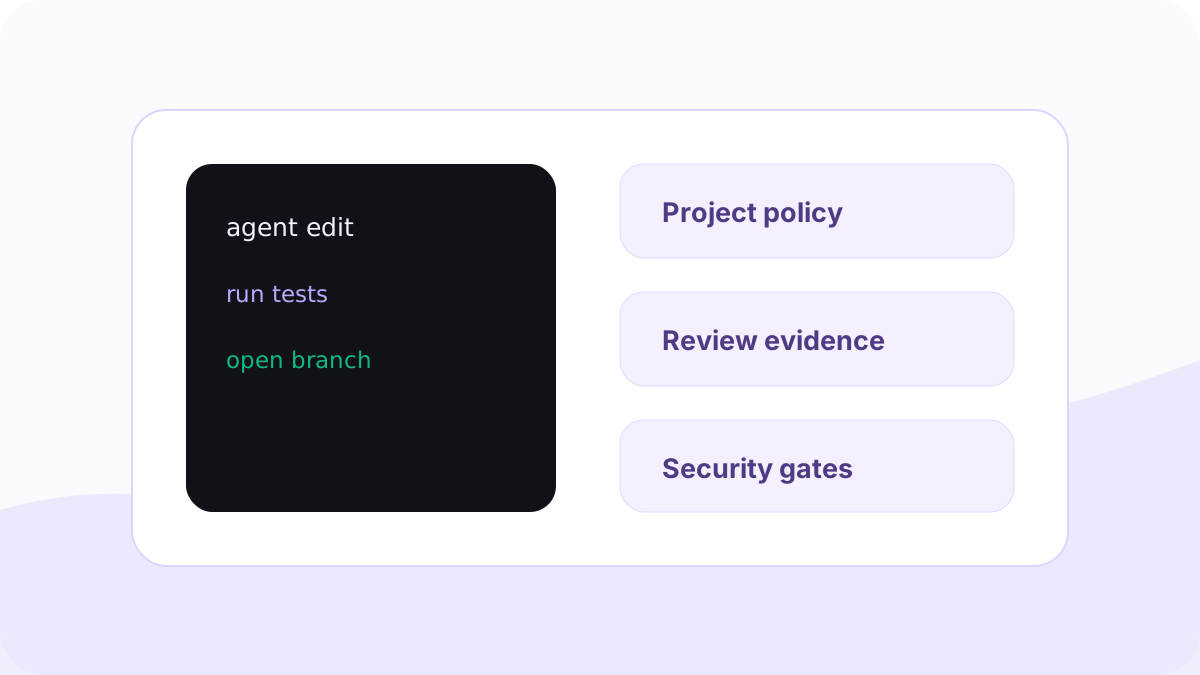
That is a different job from GitGhost. GitGhost is not an editor replacement. GitGhost is the governed delivery layer for AI coding work after an agent starts changing a real project. It is where the team tracks the session, branch, policy, approvals, scanner results, pipeline status, and merge evidence.
Editor intelligence and delivery governance solve different problems
Editor AI helps an individual developer move faster. It can answer questions, edit files, explain code, generate tests, and iterate inside the workspace. That is valuable. But the team still needs to decide what happens when generated work becomes a branch, pull request, release candidate, or production change.
Delivery governance asks a different set of questions:
- Which project policy allowed the agent to act?
- Was this a local agent, cloud agent, or human action?
- Which branch and merge request belong to the session?
- Which files changed, and were they inside the intended scope?
- Which scanners, tests, and pipelines passed?
- Who approved the final change?
| Workflow need | Cursor | GitGhost |
|---|---|---|
| Writing and editing code | Strong editor-first AI experience for local development. | Connects the resulting work to projects, branches, review, and delivery evidence. |
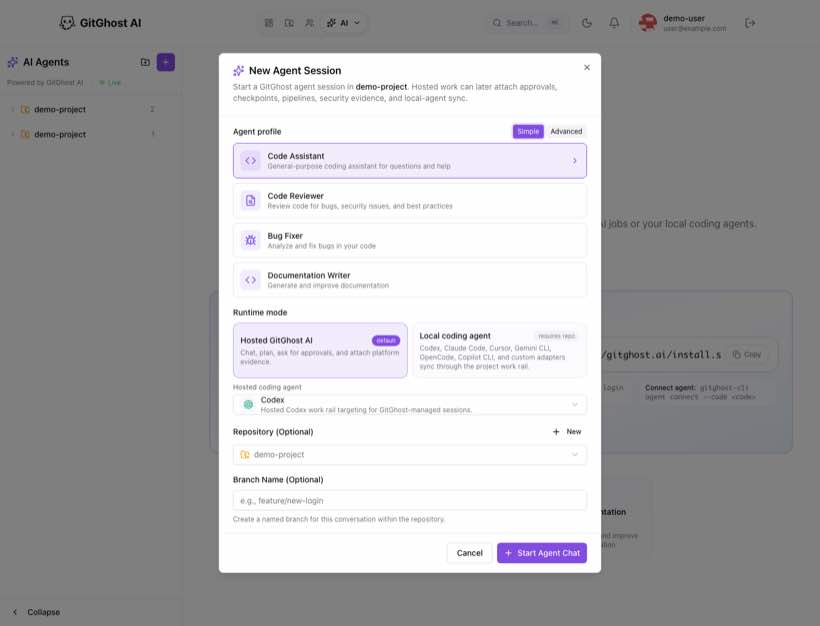
| Local agent flexibility | Focused on the Cursor environment and its agent workflows. | Built to connect multiple agents through GitGhost CLI and project-scoped connect codes. |
| Team audit trail | Some context lives in the editor or associated cloud workflow. | Agent sessions, approvals, scans, and pipeline results are represented in the project. |
| Security review | Depends on the team's external checks and repository workflow. | Security scans and findings are part of the same AI delivery surface. |
| Best fit | Developers who want a powerful AI editor. | Teams that want governed AI software delivery without forcing one editor. |
Why teams should not confuse "AI editor" with "AI platform"
A team can love Cursor and still need GitGhost. The editor is where a developer creates or explores a change. The delivery platform is where the team decides if that change should ship. Those surfaces have different audiences. Developers need speed and context. Reviewers need evidence. Security teams need traceability. Engineering leaders need repeatable controls.
GitGhost is intentionally agent-agnostic. It is designed for a world where different developers use different tools. One project may receive work from Claude Code, Codex, Cursor, Gemini, OpenCode, and a custom internal agent. The team should not have to inspect five separate histories to understand the delivery story.
What GitGhost adds after the editor
GitGhost adds the project layer that editor tools do not usually own: repository import, project membership, issue context, merge requests, CI pipelines, security scans, AI session history, approvals, and policy. That is the layer where agent work becomes something a team can review and govern.
For example, a developer can use a local coding agent to create a patch, then connect the session through GitGhost CLI:
curl -fsSL https://gitghost.ai/install.sh | bash
gitghost-cli auth login
gitghost-cli agent connect --agent claude_code --code <connect-code>
From there, the work can be tied to the project. The reviewer does not only see the final diff. They can inspect the surrounding activity and evidence.
How to choose
Choose Cursor when your main problem is improving the coding experience inside the editor. Choose GitGhost when your main problem is controlling the delivery workflow around AI-generated code. Many teams will use both: Cursor or another coding agent for creation, GitGhost for governance, review, scans, and merge confidence.