
AI coding tools are no longer side experiments. The question for engineering leaders is shifting from “should developers use assistants?” to “how do we keep agent work understandable, secure, and reviewable when it becomes part of daily delivery?”
The Stack Overflow Developer Survey 2025 describes how broadly AI tools have entered professional developer workflows. Google Cloud’s DORA research has also focused on the practical effects of AI adoption in software delivery. The direction is clear: teams are experimenting, but production-grade adoption needs more than a smarter autocomplete box.
When agents can write code, run commands, and change project state, the product surface around the agent matters as much as the model.
The old workflow was built for humans only
Traditional Git hosting assumes the developer is the primary actor. A person opens an issue, writes a branch, pushes commits, opens a merge request, waits for CI, responds to review, and merges. That model still matters, but it leaves gaps when the work was planned, generated, or modified by an agent.
Teams need to answer questions that a normal commit history does not capture well:
- Which prompt or task started the work?
- Which agent produced the patch?
- Which files changed because of an agent action?
- Which permissions did the agent have?
- Which approvals happened before risky actions?
- Which scans and pipelines verified the result?
Without those answers, AI-assisted development can look fast in the moment and opaque after the fact. That is the risk GitGhost is designed to reduce.
GitGhost treats agent work as first-class delivery work
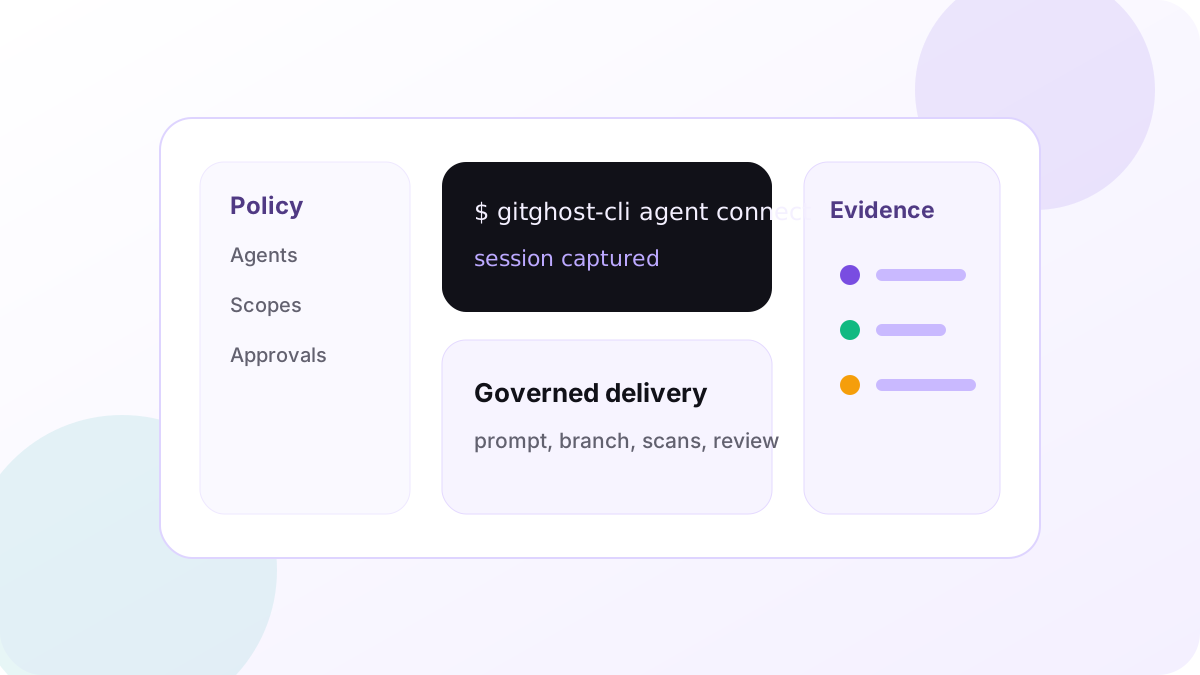
GitGhost brings repositories, issues, merge requests, pipelines, security scans, AI chat, local coding agents, and review evidence into one governed workspace. The goal is simple: let developers use powerful agents while the team keeps ownership of the workflow.
Instead of scattering agent context across terminal history, chat windows, local files, and CI logs, GitGhost connects the work into a single project timeline. A session can be tied to a project, an issue, a branch, a patch, an approval request, and a merge request. That gives reviewers a path from intention to outcome.
The control plane pattern
A control plane for AI coding agents should not slow every developer interaction. It should create a clear boundary around the moments that matter: project access, write permissions, branch creation, command execution, secret use, scan results, approvals, and merge evidence.
GitGhost’s product direction follows that pattern:
- Connect agents: use GitGhost CLI to link local tools like Claude Code, Codex, Gemini, Cursor, or OpenCode to a project.
- Apply policy: configure what agents are allowed to do and when human approval is required.
- Capture evidence: keep transcripts, checkpoints, file changes, branch metadata, scans, and pipeline results close to the merge request.
- Review in context: inspect why the change exists, what the agent touched, and which gates passed before merge.
What this changes for teams
The value is not just speed. Speed without confidence creates a new review burden. The higher-value outcome is a repeatable workflow where agent help remains visible and governed.
For a developer, that means keeping their preferred coding agent without losing the project workflow. For a reviewer, it means seeing the session and evidence behind a change. For a team lead, it means policy and auditability are built into the platform instead of reconstructed after an incident.
That is the reason GitGhost exists: AI coding agents are becoming part of software delivery, and software delivery needs a place where human judgment, automated checks, and agent output meet.