
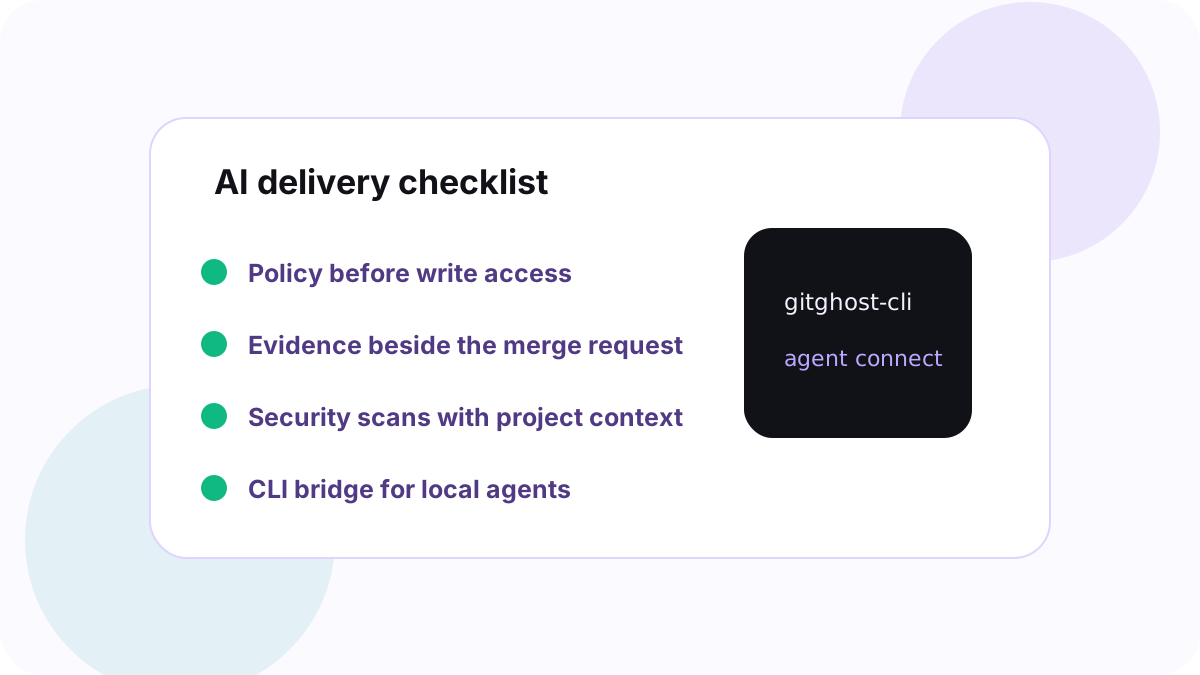
AI coding tools are multiplying quickly. Some are editor assistants. Some are terminal agents. Some are cloud agents that work on issues. Some focus on code review. Some focus on security scanning. Buying or adopting the right platform starts with a clearer question: are you choosing a coding assistant, or are you choosing the system that governs AI-assisted delivery?
This buyer's guide is written for engineering leaders, platform teams, and security reviewers who expect AI agents to become part of normal software delivery in 2026. It compares the categories that matter and shows where GitGhost fits.
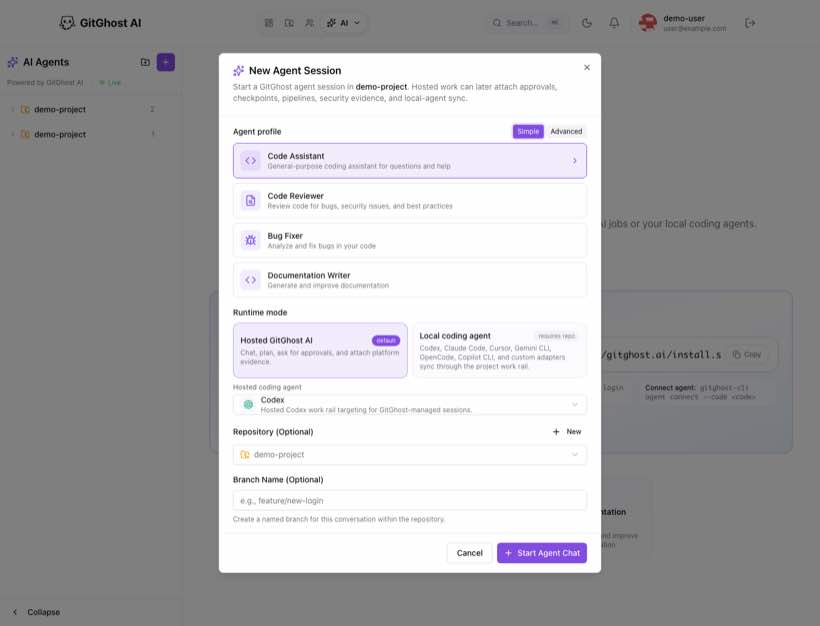
Start with the workflow, not the model
Model quality matters, but it is not the whole buying decision. The platform around the model determines whether a team can safely use AI at scale. A great answer in a chat window is not enough if the resulting code is hard to trace, review, secure, or explain later.
Official product docs from OpenAI Codex, Claude Code, Cursor, and GitHub Copilot coding agent show how quickly agentic coding interfaces are expanding. That makes the governance layer more important, not less.
The five platform categories
| Category | Typical strength | Common gap | Where GitGhost fits |
|---|---|---|---|
| Editor AI | Fast code editing, explanations, tests, refactors. | Team-level delivery evidence may stay outside the editor. | Connects resulting work to project policy, review, scans, and pipelines. |
| Terminal agents | Deep local workspace control and command execution. | Session history may remain private or local-only. | GitGhost CLI links local agents to a governed project workflow. |
| Cloud coding agents | Issue-to-branch or issue-to-PR automation. | May be tied to one platform or assistant. | Supports a multi-agent control plane around delivery outcomes. |
| AI review bots | Pull request feedback and review acceleration. | Usually starts after the branch already exists. | Keeps agent intent, policy, scans, approvals, and CI evidence together. |
| Security scanners | Finding vulnerabilities, secrets, dependencies, and container risks. | Scanner output can be disconnected from the AI session that caused the change. | Attaches scanner evidence to the project and merge workflow. |
Your evaluation checklist
Before standardizing on an AI coding platform, ask these questions in a real project, not a demo repository:
- Agent choice: can developers use the agents they already trust, or must everyone move to one assistant?
- Authentication: can the CLI and web app authenticate cleanly without leaking tokens into Git remotes or shell history?
- Project policy: can the team decide which agents may connect and what they can do?
- Approval gates: can risky actions require human review before they happen?
- Security scans: are SAST, dependency audit, secret scanning, and container scanning visible beside the branch?
- CI evidence: can reviewers see pipeline status and artifacts without switching tools?
- Audit trail: can the team explain later who asked for the work, which agent acted, and why it was merged?
- Portability: does the workflow survive if the team changes editor, model, or coding agent?
Where GitGhost is different
GitGhost is designed as the control surface for AI-assisted software delivery. It includes Git hosting primitives, but the product direction is broader than repositories. It brings together AI chat, local agent pairing, project policy, security scans, CI pipelines, merge requests, and project activity so the delivery story is visible in one place.
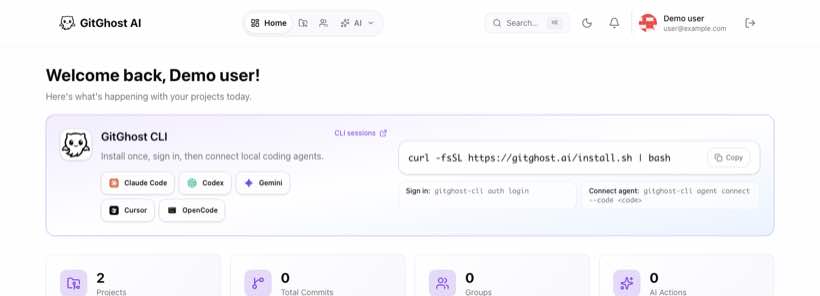
The GitGhost CLI is a core part of that approach. Developers can install it once and connect local agents without giving every agent unlimited project access:
curl -fsSL https://gitghost.ai/install.sh | bash
gitghost-cli auth login
That matters because the future of AI development is not one tool. It is many agents, many editors, and many workflows. The platform that wins for teams will be the one that makes all of that work governable.
Recommendation
If your team is evaluating AI coding tools in 2026, do not only compare code generation quality. Compare the full delivery workflow. The winning setup should help developers move faster while making reviewers, security teams, and engineering leaders more confident.
Use editor AI for creation. Use specialized scanners where they are strongest. Use review bots if they improve pull request feedback. Use GitGhost when you need the governed layer that ties agent activity, project policy, security evidence, CI, approvals, and merge decisions into one workflow.