
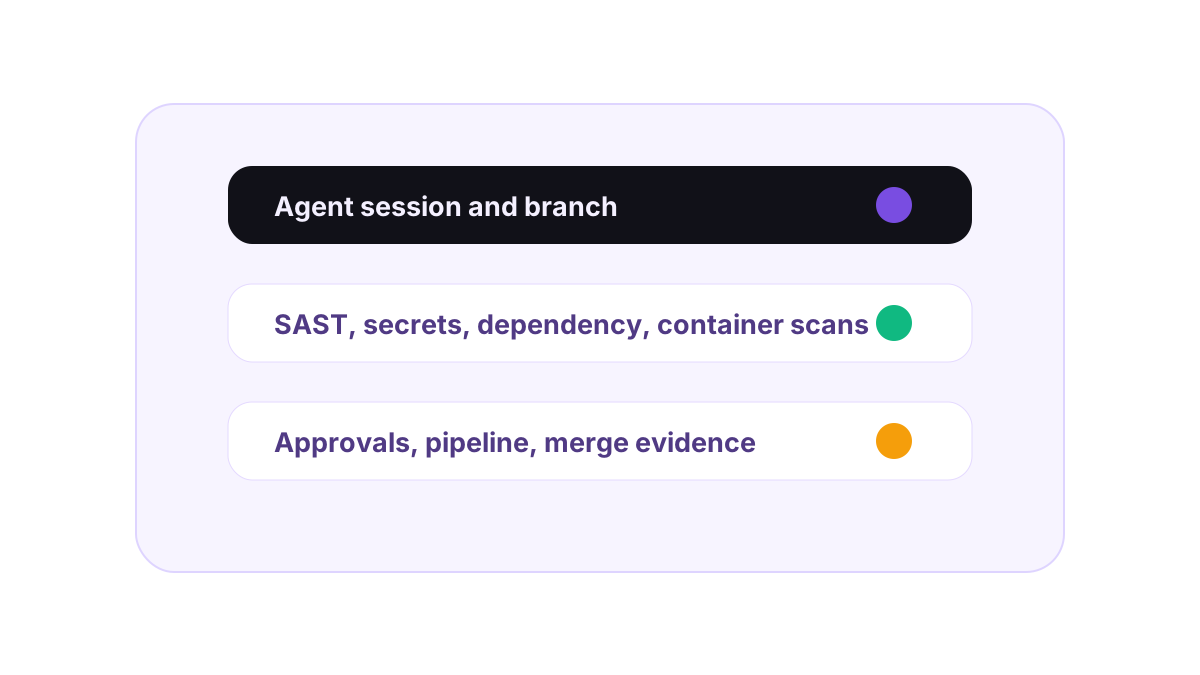
AI-generated code does not remove the need for security review. It increases the need for clear evidence. A generated patch can introduce vulnerable dependencies, miss project conventions, expose secrets, or make a change that looks right in isolation but risky inside the system.
Tools such as Snyk Code, CodeRabbit, and GitLab Duo each address important parts of the modern development workflow. GitGhost is focused on a specific gap: connecting AI agent activity to security scans, approval gates, CI evidence, and merge decisions in one governed project workflow.
The security problem is fragmented evidence
Most engineering teams already have several security tools. One scanner checks code patterns. Another checks dependencies. Another catches secrets. A review bot comments on a pull request. CI runs tests. The AI conversation may live in a terminal, editor, chat transcript, or cloud task.
The result is not always a lack of tools. The result is fragmentation. When a reviewer asks, "Is this AI-generated change safe to merge?", the answer may require searching across multiple products and logs. GitGhost is designed to reduce that search by making the agent session, branch, scans, approvals, pipeline results, and merge request part of the same project record.
| Tool category | What it is good at | What GitGhost adds |
|---|---|---|
| Snyk-style security scanning | Finding vulnerable code patterns, dependencies, containers, and related security issues. | Connects scanner output to the AI session, branch, approval state, and merge workflow. |
| CodeRabbit-style AI review | Adding AI-assisted review comments and pull request feedback. | Keeps review evidence beside project policy, scan gates, CI runs, and agent activity. |
| GitLab Duo-style platform AI | Adding AI features inside an existing DevSecOps platform. | Focuses on agent-agnostic governance and local agent connectivity for teams using several coding tools. |
| GitHub Copilot-style coding agent | Creating implementation work from issues and pull request workflows. | Controls the delivery path around many agents, not only one assistant. |
Security for AI code starts before the pull request
By the time a pull request exists, the agent has already made important choices. It selected files, changed logic, added or removed dependencies, ran commands, and possibly touched secrets or configuration. A secure AI workflow should track those choices before review begins.
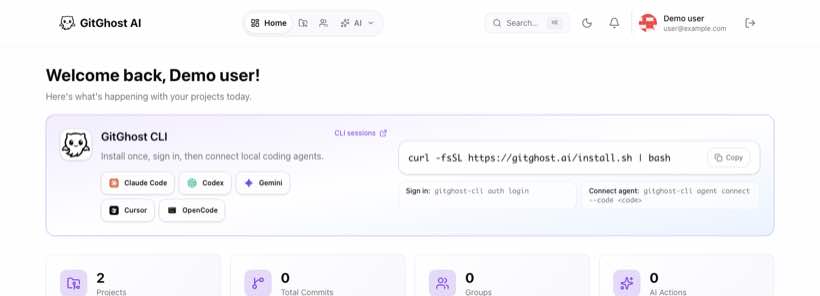
GitGhost's agent workflow is built around that earlier visibility. A local agent can connect through GitGhost CLI. A project can define whether local agent sync is allowed. A generated connect code links the agent to a specific project. The team can then evaluate the work with context instead of treating the branch as a mystery patch.
What a good AI security review should include
A serious review of AI-generated code should answer at least these questions:
- Which user and agent started the work?
- Which task, issue, or prompt defined the goal?
- Which files and dependencies changed?
- Which security scanners ran against this branch?
- Did CI pass, fail, or skip?
- Were approval requirements satisfied before merge?
- Can the team audit the path later?
This is where GitGhost's value is different from a standalone scanner or review bot. The platform is not just looking for one class of defect. It is organizing the evidence needed to make a merge decision.
Best platform by use case
| Use case | Best starting point | Why |
|---|---|---|
| You need vulnerability and dependency scanning | Snyk or a similar scanner | Specialized scanners are strong at finding known security problems. |
| You need AI pull request comments | CodeRabbit or similar review tooling | Review bots can reduce reviewer effort on a specific PR. |
| You need integrated DevSecOps AI in GitLab | GitLab Duo | It fits teams already standardized on GitLab's platform. |
| You need agent governance across tools | GitGhost | It connects agent sessions, project policy, scans, approvals, CI, and merge evidence. |
The practical answer is not always either-or. GitGhost can sit beside specialized security tools and make their output more useful by attaching it to the full AI delivery story.